
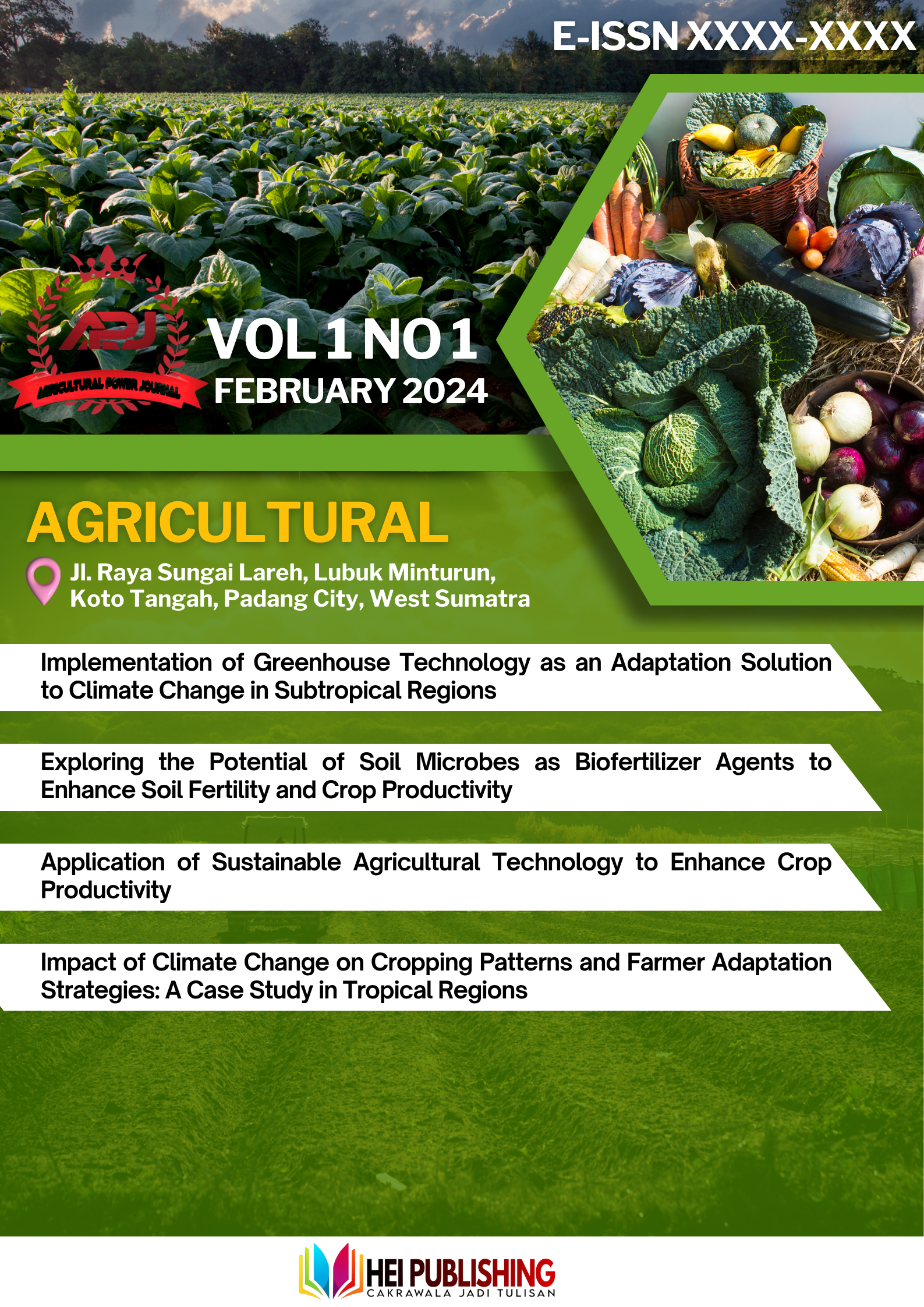
Exploring the Potential of Soil Microbes as Biofertilizer Agents to Enhance Soil Fertility and Crop Productivity
DOI:
https://doi.org/10.70076/apj.v1i1.19Keywords:
Soil Microbes, Biofertilizers, Soil Fertility, Crop Productivity, Sustainable Agriculture, Nutrient Cycling, Nitrogen Fixation, Phytohormones, Soil Health, Agricultural PracticesAbstract
The potential of soil microbes as biofertilizer agents to enhance soil fertility and crop productivity has garnered increasing attention in recent years. This study investigates the role of various soil microorganisms, including bacteria, fungi, and actinomycetes, in promoting plant growth and improving soil health. By examining the mechanisms through which these microbes contribute to nutrient cycling, nitrogen fixation, and phytohormone production, we aim to understand their impact on crop yields and soil properties. Field trials conducted in diverse agricultural settings demonstrate that the application of microbial biofertilizers can lead to significant improvements in crop productivity and soil fertility. The findings suggest that incorporating soil microbes into sustainable agricultural practices could be a viable strategy to reduce dependency on chemical fertilizers and enhance long-term soil health
References
Adesemoye, A. O., Torbert, H. A., & Kloepper, J. W. (2009). Plant growth-promoting rhizobacteria allow reduced application rates of chemical fertilizers. Microbial Ecology, 58(4), 921-929
Alori, E. T., Glick, B. R., & Babalola, O. O. (2017). Microbial phosphorus solubilization and its potential for use in sustainable agriculture. Frontiers in Microbiology, 8, 971.
Bhattacharyya, P. N., & Jha, D. K. (2012). Plant growth-promoting rhizobacteria (PGPR): Emergence in agriculture. World Journal of Microbiology and Biotechnology, 28(4), 1327-1350.
Glick, B. R. (2012). Plant growth-promoting bacteria: Mechanisms and applications. Scientifica, 2012, 963401.
Hamblin, A. (2001). Biofertilizers in action. Australian Journal of Soil Research, 39(3), 627-643
Jeffries, P., Gianinazzi, S., Perotto, S., Turnau, K., & Barea, J. M. (2003). The contribution of arbuscular mycorrhizal fungi in sustainable maintenance of plant health and soil fertility. Biology and Fertility of Soils, 37(1), 1-16.
Mäder, P., Kaiser, F., Adholeya, A., Singh, R., Uppal, H. S., & Sharma, A. K. (2011). Inoculation of arbuscular mycorrhizal fungi enhances root colonization, plant growth, and nutrient uptake in paddy rice grown under lowland conditions. Applied Soil Ecology, 48(2), 212-217.
Malusá, E., & Vassilev, N. (2014). A contribution to set a legal framework for biofertilizers. Applied Microbiology and Biotechnology, 98(15), 6599-6607.
Pandey, P., Maheshwari, D. K., & Bajpai, V. K. (2010). Plant growth-promoting rhizobacteria: Potential microbes for sustainable agriculture. In Maheshwari, D. K. (Ed.), Plant Growth and Health Promoting Bacteria (pp. 193-222). Springer. doi:10.1007/978-3-642-13612-2_10
Rillig, M. C., & Mummey, D. L. (2006). Mycorrhizas and soil structure. New Phytologist, 171(1), 41-53.
Smith, S. E., & Read, D. J. (2008). Mycorrhizal Symbiosis (3rd ed.). Academic Press. ISBN: 9780123705266
Vessey, J. K. (2003). Plant growth promoting rhizobacteria as biofertilizers. Plant and Soil, 255(2), 571-586.
Wu, S. C., Cao, Z. H., Li, Z. G., Cheung, K. C., & Wong, M. H. (2005). Effects of biofertilizer containing N-fixer, P and K solubilizers and AM fungi on maize growth: A greenhouse trial. Geoderma, 125(1-2), 155-166.
Zahir, Z. A., Arshad, M., & Frankenberger, W. T. (2004). Plant growth promoting rhizobacteria: Applications and perspectives in agriculture. Advances in Agronomy, 81, 97-168.
Zhang, H., Kim, M. S., Sun, Y., Dowd, S. E., Shi, H., & Paré, P. W. (2008). Soil bacteria confer plant salt tolerance by tissue-specific regulation of the sodium transporter HKT1. Molecular Plant-Microbe Interactions, 21(6), 737-744
Downloads
Published
How to Cite
Issue
Section
License
Copyright (c) 2024 Agriculture Power Journal (APJ)

This work is licensed under a Creative Commons Attribution 4.0 International License.