
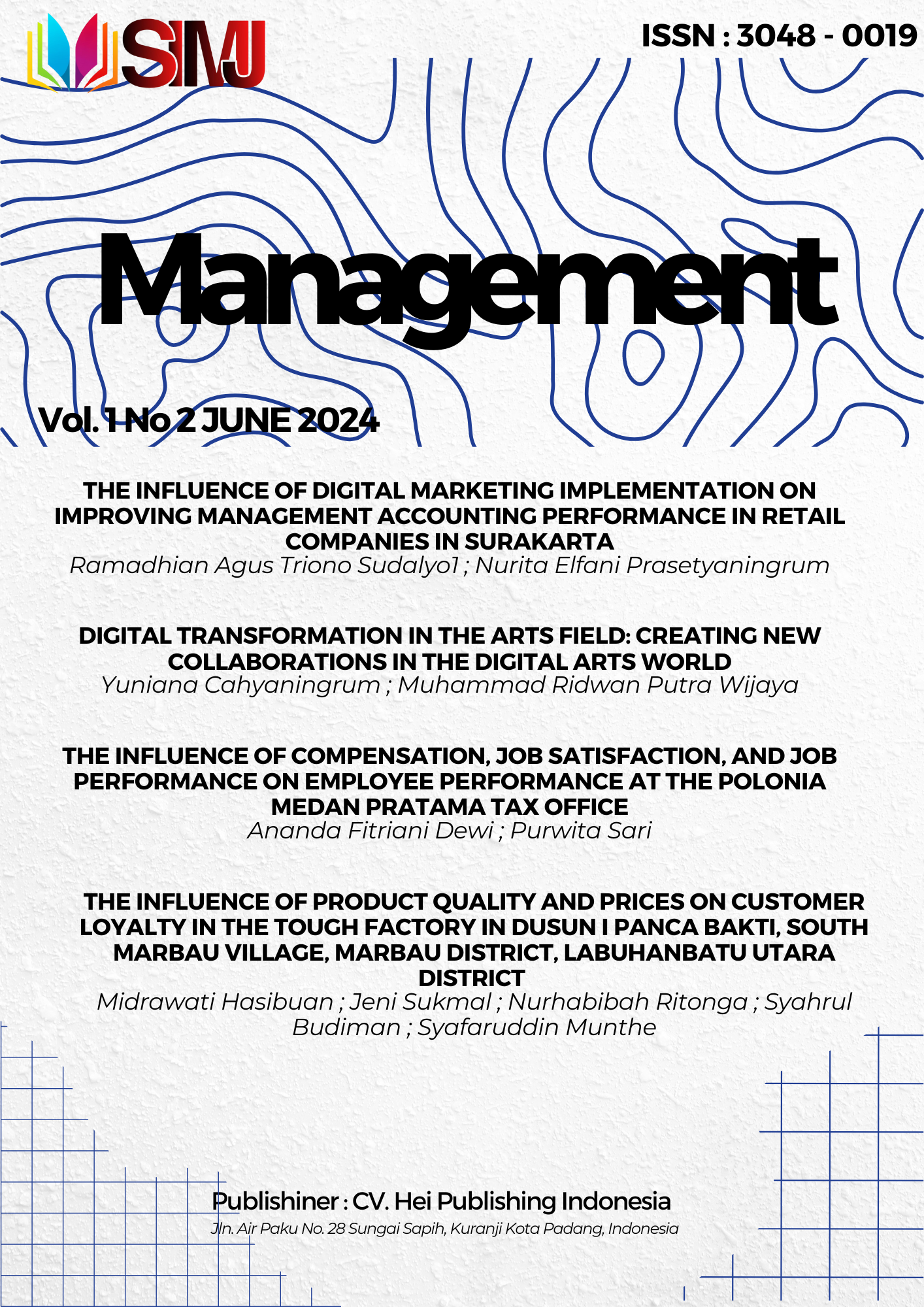
Digital Transformation in the Arts Field: Creating New Collaborations in the Digital Arts World
DOI:
https://doi.org/10.70076/simj.v1i2.32Keywords:
digital transformation, collaboration, innovation, artAbstract
Digital transformation has become a major catalyst in changing the way artists create and collaborate in the art world. This article examines how technological advances, including artificial intelligence (AI), augmented reality (AR), virtual reality (VR), and blockchain, are creating new collaborative opportunities for artists. These technologies not only expand the mediums and methods of artistic expression but also introduce new ways for artists to interact and collaborate, both locally and globally. Through analysis of various case studies and interviews with artists, this article reveals the significant impact of digitalization on the creative process and distribution of works of art. In addition, this article also highlights the challenges faced in adopting digital technology, including copyright issues, data security, and changing art market dynamics. In doing so, this article provides a comprehensive view of how digital transformation is driving collaboration and innovation in the arts world, as well as its implications for the future of the arts industry.
References
Z. Hussain, “Paradigm of technological convergence and digital transformation: The challenges of CH sectors in the global COVID-19 pandemic and commencing resilience-based structure for the post-COVID-19 era,” Digit. Appl. Archaeol. Cult. Herit., vol. 21, no. March, p. e00182, 2021, doi: 10.1016/j.daach.2021.e00182.
I. W. Sugita, M. Setini, and Y. Anshori, “Counter hegemony of cultural art innovation against art in digital media,” J. Open Innov. Technol. Mark. Complex., vol. 7, no. 2, p. 147, 2021, doi: 10.3390/joitmc7020147.
C. Temple Jones, C. Rice, M. Lam, E. Chandler, and K. Jiwon Lee, “Toward TechnoAccess: A narrative review of disabled and aging experiences of using technology to access the arts,” Technol. Soc., vol. 65, no. March, p. 101537, 2021, doi: 10.1016/j.techsoc.2021.101537.
Y. Ye et al., “Generative AI for visualization: State of the art and future directions,” Vis. Informatics, vol. 8, no. 2, pp. 43–66, 2024, doi: 10.1016/j.visinf.2024.04.003.
Z. Liu and S. Chang, “A study of digital exhibition visual design led by digital twin and VR technology,” Meas. Sensors, vol. 31, no. June 2023, p. 100970, 2024, doi: 10.1016/j.measen.2023.100970.
M. van Meeteren, F. Trincado-Munoz, T. H. Rubin, and T. Vorley, “Rethinking the digital transformation in knowledge-intensive services: A technology space analysis,” Technol. Forecast. Soc. Change, vol. 179, no. March, p. 121631, 2022, doi: 10.1016/j.techfore.2022.121631.
Y. Cahyaningrum, “Optimization of Information Technology Through Intelligent System Integration : Comprehensive Exploration,” J. Intell. Syst. Inf. Technol., vol. 1, no. 1, pp. 1–5, 2024.
Y. Cahyaningrum, S. Suryono, and B. Warsito, “Fuzzy-Expert System for Indicator and Quality Evaluation of Teaching and Learning Processes Online Study Programs,” E3S Web Conf., vol. 317, p. 05021, 2021, doi: 10.1051/e3sconf/202131705021.
M. Massi, M. Vecco, and Y. Lin, Digital Transformation in the Cultural and Creative Industries; Production, Consumption and Entrepreneurship in the Digital and Sharing Economy. 2020.
Y. Cahyaningrum, “Penerapan Artificial Intelligence Dalam Dunia Pendidikan,” Amplifier, vol. 13, no. 2, pp. 62–68, 2023, [Online]. Available: https://stuvia.id/tips-belajar/artificial-intelligence-dalam-pendidikan/.
H. Zhou, R. Wang, X. Zhang, and M. Chang, “The impact of digital technology adoption on corporate supply chain concentration: Evidence from patent analysis,” Financ. Res. Lett., vol. 64, no. January, p. 105413, 2024, doi: 10.1016/j.frl.2024.105413.
Y. Cahyaningrum, “Evaluation of System Access Security in The Implementation of Multi- Factor Authentication (MFA) in Educational Institutions,” J. Pract. Comput. Sci., vol. 4, no. 1, pp. 11–19, 2024.
G. He, H. Jiang, and Y. Zhu, “The effect of digital technology development on the improvement of environmental governance capacity: A case study of China,” Ecol. Indic., vol. 165, no. October 2023, p. 112162, 2024, doi: 10.1016/j.ecolind.2024.112162.
A. Alacovska, P. Booth, and C. Fieseler, “The Role of the Arts in the Digital Transformation,” SSRN Electron. J., no. 870726, 2020, doi: 10.2139/ssrn.3715612.
P. Dias, H. Gonçalves, F. Silva, J. Duque, J. Martins, and A. Godinho, “Blockchain Technologies: A scrutiny into Hyperledger Fabric for Higher Educational Institutions",” Procedia Comput. Sci., vol. 237, pp. 213–220, 2024, doi: 10.1016/j.procs.2024.05.098.
S. Kraus, P. Jones, N. Kailer, A. Weinmann, N. Chaparro-Banegas, and N. Roig-Tierno, “Digital Transformation: An Overview of the Current State of the Art of Research,” SAGE Open, vol. 11, no. 3, 2021, doi: 10.1177/21582440211047576.
Downloads
Published
How to Cite
Issue
Section
License
Copyright (c) 2024 Smart International Management Journal

This work is licensed under a Creative Commons Attribution-ShareAlike 4.0 International License.