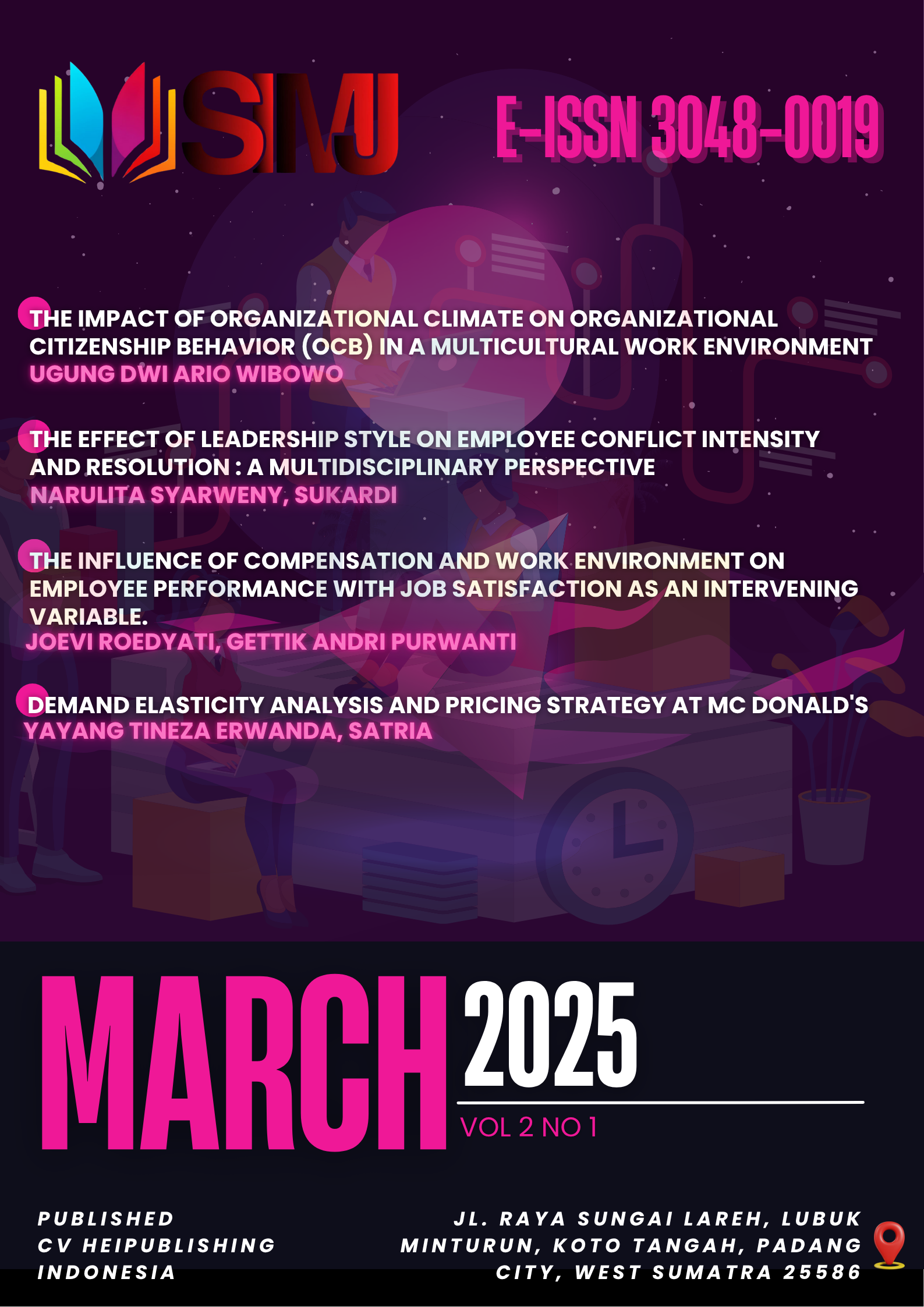
The Influence of Leadership Style on Employee Conflict Intensity and Resolution: A Multidisciplinary Perspective
DOI:
https://doi.org/10.70076/simj.v2i1.56Keywords:
leadership style, conflict intensity, conflict resolution, transformational leadership, collaborative strategyAbstract
The purpose of this study is to examine, from a multidisciplinary standpoint, how leadership style affects the severity and settlement of employee conflicts. A questionnaire evaluating leadership style, conflict severity, and conflict resolution techniques was used to gather data from 100 respondents using a quantitative method and a cross-sectional design. Regression analysis results indicated that authoritarian leadership style positively contributed to rising conflict intensity (β = 0.32, p <.01), but transformational leadership style significantly decreased conflict intensity (β = -0.45, p <.001). Furthermore, it was demonstrated that cooperative conflict resolution techniques were successful in lowering stress at work (r = -.56, p <.001). These results demonstrate how crucial flexible and communicative leaders are to fostering a positive and effective workplace. Nevertheless, this study has drawbacks, such as a sample size restricted to a few business sectors and a cross-sectional design that precludes drawing conclusions about causality. It is advised that further study be done to examine how technology use and organizational cultural setting affect dispute resolution.
References
Bass, B. M. (1990). Leadership and Performance Beyond Expectations. Free Press.
Burns, J. M. (1978). Leadership. Harper & Row.
Lewin, K., et al. (1939). Patterns of Aggressive Behavior in Experimentally Created Social Climates. Journal of Social Psychology, 10(2), 271-299.
Rahim, M. A. (2011). Managing Conflict in Organizations. Transaction Publishers.
De Dreu, C. K. W., & Van Vianen, A. E. M. (2001). Managing Relationship Conflict and the Effectiveness of Organizational Teams: The Moderating Role of Task Interdependence and Team Potency. Academy of Management Journal, 44(4), 779-790.
Hofstede, G., et al. (1991). Cultures and Organizations: Software of the Mind. McGraw-Hill.
Thomas, K., & Kilmann, R. (1974). Thomas-Kilmann Conflict Mode Instrument (TKI). Xicom Inc.
Nugroho, A., Prihatini, D., & Syaharudin, M. (2023). Pengaruh Gaya Kepemimpinan Transformasional Terhadap Penyelesaian Konflik Dan Kinerja Karyawan Hotel Asri Jember.
Widiyanto (2018). Pengaruh Gaya Kepemimpinan Terhadap Resolusi Konflik Organisasi.
Pruitt, D.G., & Carnevale, P.J. (2004). Negotiation in Social Conflict. McGraw-Hill.
Downloads
Published
How to Cite
Issue
Section
License
Copyright (c) 2025 Smart International Management Journal

This work is licensed under a Creative Commons Attribution 4.0 International License.